Global B2B Roll Forming Sourcing Platform | Free RFQ Response within 24h

- Tuo AI

- Live

- My Account
- Shopping Cart
- Inquiry Basket
- Contact Us
- Back to Top




Thrie Beam Guardrails
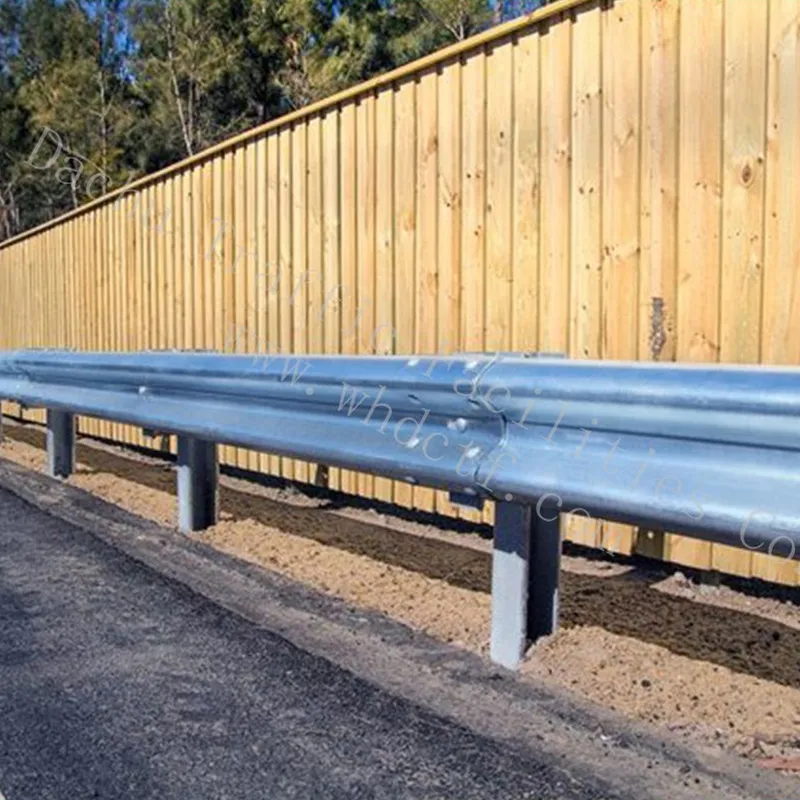
Thrie beam guardrails are high-containment triple-wave corrugated highway barriers engineered to provide superior impact absorption and vehicle redirection along dangerous highway sections, bridge approaches, and industrial corridors. Cold-formed from 3.0 mm to 4.0 mm high-strength structural steel strip (conforming to AASHTO M180 Class A and Class B), Thrie beams feature a 506 mm cross-sectional height and 83 mm wave depth—providing 1.5 times the vertical capture area and higher moment of inertia than standard two-wave W-beams. Dedicated roll forming lines integrate 10–15 ton hydraulic decoilers, multi-stage hydraulic hole-punching dies for splice and post mounting, 16–22 heavy-duty forming stands, and hydraulic cut-off shears. Browse certified profile dimensions, turnkey roll forming machinery, and complete highway barrier solutions below.
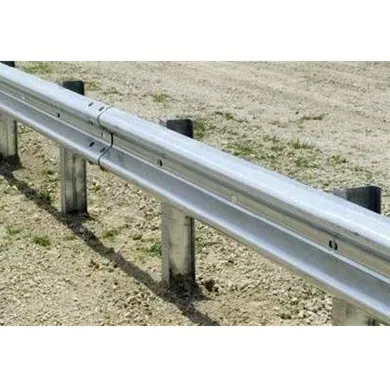 Guardrail and Roadside Safety Barrier Hot Dip Galvanized Surface Treatment Customized Size Factory Direct Supply Guardrails
- Hubei, China+DACHU+Three Beam Guardrail+Q235 Q345+Customized
$1,080.00
MOQ: 1
 Bridge Guardrail for Highway Roadside Safety From Factory Direct Sales Guardrails
- Hubei, China+DACHU+Q235/Q355+Hot Dipped Galvanized+4320*506*85*3mm/Customized
$27.99
MOQ: 5
 Dipped Galvanized Traffic Barriers High Speed Crash Guardrail for Factory Direct Sale
- Hubei, China+Dachu+Stainless steel+Silver+traffic safety Thrie-beam guardrail
$60.00
MOQ: 5
 GS2/GS4 Galvan Barrier Shock-resisting Guardrail for Factory Direct Sale
- Hubei, China+Dachu+Stainless steel+Silver+traffic safety Thrie-beam guardrail
$18.00
MOQ: 5
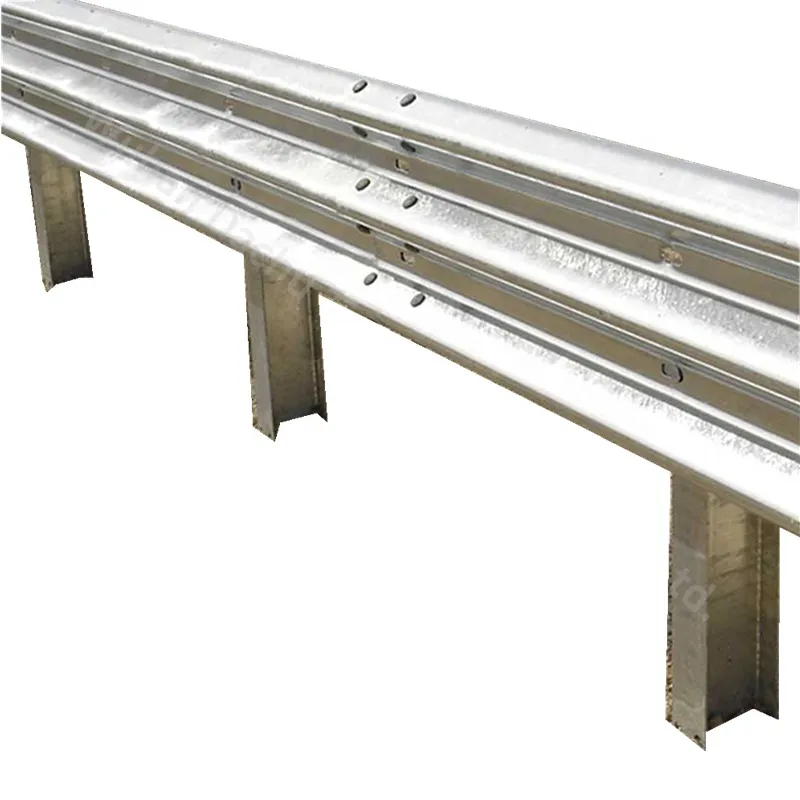 Supplier EN 1317 Steel Thrie Beam Highway Roadway Barrier Crash Guardrail
- Tianjin, China+Engineer Grade+Dachu+Thrie-Beam Guardrail+steel q235,q355,custom
$60.00
MOQ: 1
 EN 1317 Galvanized Steel Guardrail Thrie-Beam Highway Guard Rail Crash Barrier
- Tianjin, China+Engineer Grade+Dachu+Thrie-Beam Guardrail+steel q235,q355,custom
$60.00
MOQ: 1
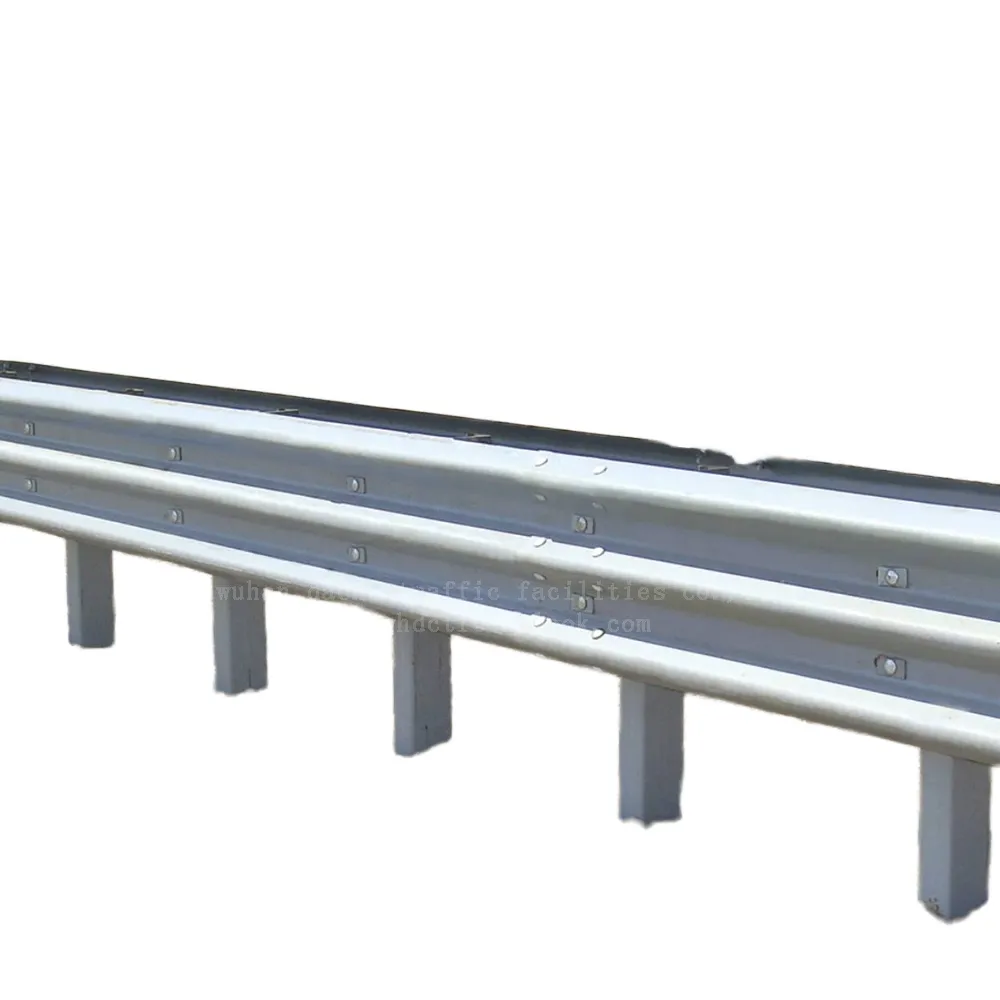 Anti-Corrosion Steel Corrugated Highway Guardrail Traffic Safety Barrier with Three-Beam Crash Durable Metal Material
- Tianjin, China+Engineer Grade+Dachu+Thrie Beam Guardrail+Steel q235,q355,custom
$60.00
MOQ: 1




About Thrie Beam Guardrails
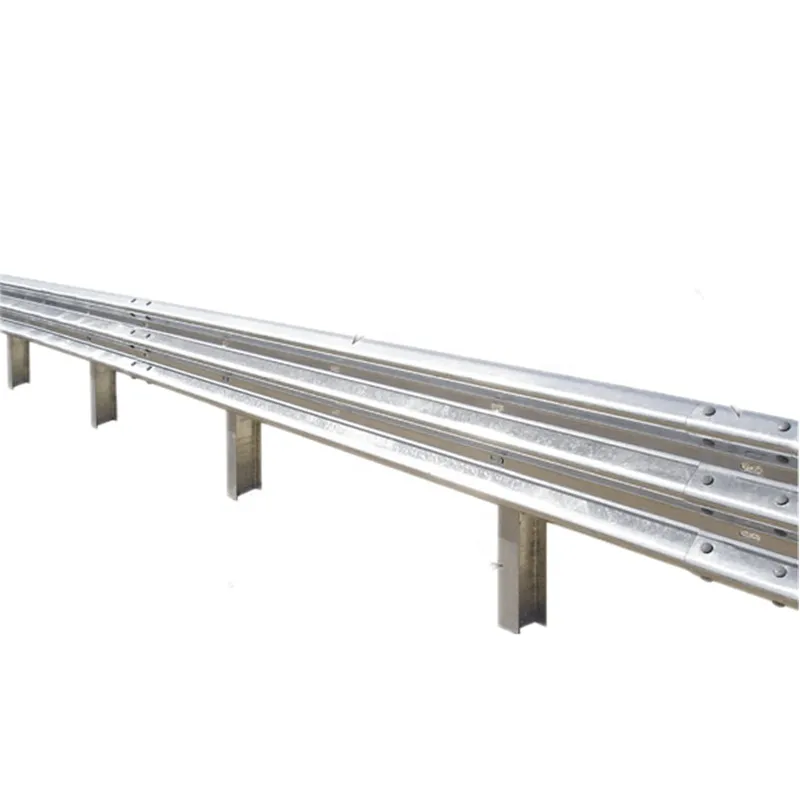
Thrie beam guardrails represent the heavy-duty tier of highway containment systems, specifically developed to safely capture and redirect larger vehicles—such as freight trucks, intercity coaches, and commercial SUVs—that possess higher centers of gravity. By adding a third corrugated crest, the overall beam height expands from 312 mm (standard W-beam) to 506 mm, significantly reducing the probability of vehicle vaulting, bumper underride, or barrier override during oblique high-velocity collisions.
Manufacturing Thrie beams requires heavy-gauge cold roll forming technology capable of bending 3.0 mm to 4.0 mm structural carbon steel (typically Q235B, Q355B, or ASTM A36) without tensile tearing. Modern production lines begin with an automatic hydraulic decoiler and precision leveling station to eliminate coil curvature. Next, high-tonnage hydraulic punch units pierce standard 12-bolt splice slot patterns and post-mounting slots before cold forming. Material then advances through 18 to 22 reinforced forming stands with solid Φ85–105 mm alloy steel shafts, progressively shaping the three distinct 83 mm deep corrugations before a profiled hydraulic blade cuts each section to standard lengths (commonly 4320 mm or 3810 mm).
Corrosion protection is achieved through heavy hot-dip galvanizing conforming to AASHTO M180 / ASTM A123 (yielding coating weights of 550 g/m² for standard environments or 1100 g/m² for coastal marine regions), or electrostatically applied polyester powder coating for enhanced roadside aesthetics.
These barriers serve critical roles along high-speed expressway medians, steep mountain ravines, bridge approach transition sections, and hazardous roadside fixed structures where maximum containment (TL-4 / TL-5 under MASH, H2 / H3 under EN 1317) is legally mandated.
Applications
Mountainous Highways & High-Embankment Curves
In mountainous highways & high-embankment curves, high-containment Thrie-beam guardrails prevent heavy vehicles and buses from rolling over or breaching steep drop-off embankments across sharp radius mountain highway curves. These heavy-duty highway safety barriers provide vital roadside impact containment, shielding motorists from roadside drop-offs and bridge structures.
Bridge Viaducts & Rigid-to-Semi-Rigid Transitions
In bridge viaducts & rigid-to-semi-rigid transitions, thrie-beam sections form gradual stiffness transitions between semi-rigid roadside W-beam guardrails and rigid concrete bridge parapets, preventing pocketing and vehicle snagging. Engineered with deep corrugations and heavy steel posts, these certified highway safety assemblies deliver superior impact dissipation and prevent median crossovers.
Highway Medians & Cross-Over Head-On Prevention
In highway medians & cross-over head-on prevention, back-to-back double-sided Thrie-beam median barriers contain high-speed out-of-control trucks, preventing catastrophic cross-median penetration into opposing traffic lanes. Manufactured from high-strength steel and hot-dip galvanized for durability, these crashworthy barriers absorb collision energy conforming to AASHTO M180 standards.
Industrial Freight Corridors & Heavy-Truck Highways
In industrial freight corridors & heavy-truck highways, with an extended 506 mm profile height and superior section modulus, Thrie beams withstand higher center-of-gravity impacts from loaded freight trucks along industrial logistics arteries. These engineered industrial systems and accessories provide vital structural and operational support, ensuring seamless equipment integration and robust weather protection.
Bridge Piers, Toll Plazas & Roadside Hazard Shielding
In bridge piers, toll plazas & roadside hazard shielding, heavy-duty 4.0 mm Thrie beams wrap around high-risk bridge abutments, overhead sign gantries, and toll islands, dissipating severe crash energy to safeguard highway infrastructure. Built for heavy industrial service, these precision-engineered components resist mechanical wear and environmental corrosion, maintaining structural alignment and building performance.
Technical Overview
| Parameter | Information |
|---|---|
| Profile / Product Family | AASHTO M180 Class A / B Thrie-beam (3-wave) highway crash barrier |
| Profile Height & Depth | Beam height 506 mm; wave depth 83 mm; pitch 159 mm |
| Material Thickness | 3.0 mm (Class A) / 4.0 mm (Class B) structural carbon steel |
| Infeed Strip Width | 750 mm (developed coil width) |
| Standard Beam Length | 4320 mm (effective span 4000 mm) / 3810 mm (effective 3500 mm) |
| Tensile & Yield Strength | Yield strength ≥345 MPa; tensile strength ≥483 MPa (Q355B / Gr.50) |
| Surface Treatment | Hot-dip galvanized (AASHTO M180 Type I: 550 g/m²; Type II: 1100 g/m²) |
| Splice Hole Pattern | Standard 12-bolt splice slot configuration with post-mounting oval slots |
| Roll Forming Line Configuration | 18–22 stands, solid Φ90–105 mm shafts, individual gearbox drive |
| Impact Containment Level | MASH TL-4 / TL-5; EN 1317 H2 / H3 / H4b containment certified |
Related Solutions
Highway W-Beam Guardrail Roll Forming Line
Full line for W-beam guardrail (thrie-beam optional). In-line punching, galvaniz…
Bridge Railing and Pedestrian Guardrail System
Roll forming and fabrication solution for bridge and pedestrian railing posts an…
Guardrail and Fence Roll Forming Solution
Highway W-beam guardrail line with 2-wave / 3-wave swap modules. Example: 3.0 mm…
Heavy Coil Handling Solution
Coil infeed is a weight class plus a drive: manual expand, electric expand with…
Perimeter Fencing Production Solution
A fence search is a picket and rail family, not one mill. Square + profile palis…
Custom Profile Roll Forming for OEM
Flexible roll forming line for custom cross-sections. Suitable for OEMs who need…
Related Information

Guardrail Roll Forming Machine: W-Beam and Thrie-Beam Highway Barrier Production
W-beam vs thrie-beam guardrail profiles, AASHTO M180 specs, machine configuratio…
Read More
Highway Guardrail Standards: AASHTO M180 vs EN 1317 Roll Forming Specs
highway guardrail standards aashto m180 en 1317 roll forming specs
Read More
Guardrail W Beam Roll Forming Machine: Specs, Line Modules & Buying Guide
guardrail w beam roll forming machine, highway guardrail machine, W beam guardra…
Read More
Highway Guardrail Roll Forming Machine: Specifications & Price Explained
highway guardrail roll forming machine specifications", "guardrail machine price…
Read More
Pre-Punching vs Post-Punching in Roll Forming
Punch the holes before or after forming? The choice changes hole accuracy, tooli…
Read More
Roll Forming Tooling Design: Material, Coating & Lifespan
Roller material choices (Cr12MoV vs D2 vs SKD11), surface coatings, flower patte…
Read More
FAQ
What are the structural differences between Thrie beam (3-wave) and standard W-beam (2-wave) guardrails?
While standard W-beams measure 312 mm in height, Thrie beams feature a third wave crest expanding overall height to 506 mm with an 83 mm corrugation depth. This enlarged vertical profile delivers a 50% greater section modulus and higher moment of inertia, preventing bumper underride and rollover for high-center-of-gravity trucks and buses.
What steel grades, thicknesses, and AASHTO standards govern Thrie beam production?
Thrie beams are classified under AASHTO M180: Class A specifies 2.67 mm (nominal 3.0 mm) base metal thickness, while Class B specifies 3.43 mm (nominal 4.0 mm) thickness for heavy-duty containment. Structural steel grades typically require minimum yield strengths of 345 MPa (50,000 psi) such as Q355B or ASTM A1011 Grade 50.
What hot-dip galvanizing standards and coating weights are required for highway certification?
Under AASHTO M180 / ASTM A123, Type I specifies a minimum average zinc coating of 550 g/m² (80 μm) on both sides for standard climates, while Type II mandates 1100 g/m² (155 μm) for highly corrosive marine coastal or chemical industrial environments, guaranteeing 30 to 50 years of maintenance-free service.
How does a Thrie-to-W-beam transition piece work on bridge approaches?
Bridge approaches require transition sections where flexible roadside W-beams gradually connect to rigid concrete bridge parapets. Asymmetrical Thrie-to-W transition beams provide a smooth stiffness gradient, eliminating abrupt stiffness changes and preventing high-speed vehicles from pocketing into immovable bridge abutments.
What machine power, shaft diameter, and station count are needed to roll form 4.0 mm Thrie beams?
Forming 4.0 mm high-yield steel across a 750 mm wide strip requires massive mechanical power: typically 22 to 30 kW dual main drive motors, Φ90–105 mm solid 40Cr forged shafts, cast-steel station frames, and 18 to 22 forming passes to achieve exact corrugation geometry without edge wavy distortion.
Can a single guardrail roll forming machine produce both W-beam and Thrie-beam profiles?
Yes, manufacturers frequently invest in combination lines. These utilize either quick-change cassette tooling (where complete sets of roller stands are swapped on common baseplates in under 45 minutes) or dual-level machines that house W-beam and Thrie-beam roller sets on stacked tiers.
What critical parameters should highway contractors verify before placing an order?
Contractors must verify the required AASHTO M180 classification (Class A 3.0 mm vs Class B 4.0 mm), total length (standard 4320 mm for 4000 mm effective post span), bolt-hole pattern (universal 12-bolt splice vs 8-bolt), galvanizing coating weight (550 or 1100 g/m²), and post spacing requirements (typically 2 m or 1.33 m).