Global B2B Roll Forming Sourcing Platform | Free RFQ Response within 24h

- Tuo AI

- Live

- My Account
- Shopping Cart
- Inquiry Basket
- Contact Us
- Back to Top




Cable Trunking & Solid Enclosed Cable Ducts
Cable trunking systems, also designated as solid bottom cable troughs or enclosed sheet metal cable ducts, provide an impenetrable protective enclosure engineered to house, shield, and route electrical wiring, communication cables, and sensitive control circuits. Roll formed from structural pre-galvanized or stainless steel, cable trunking features a continuous solid bottom and tightly fitting removable snap-on or screw-fixed covers that completely isolate cables from airborne industrial dust, liquid droplets, mechanical impact, and electromagnetic interference (EMI). Conforming to BS 4678 and IEC 61537 standards, cable trunking delivers robust containment across automated manufacturing plants, commercial offices, and healthcare facilities.
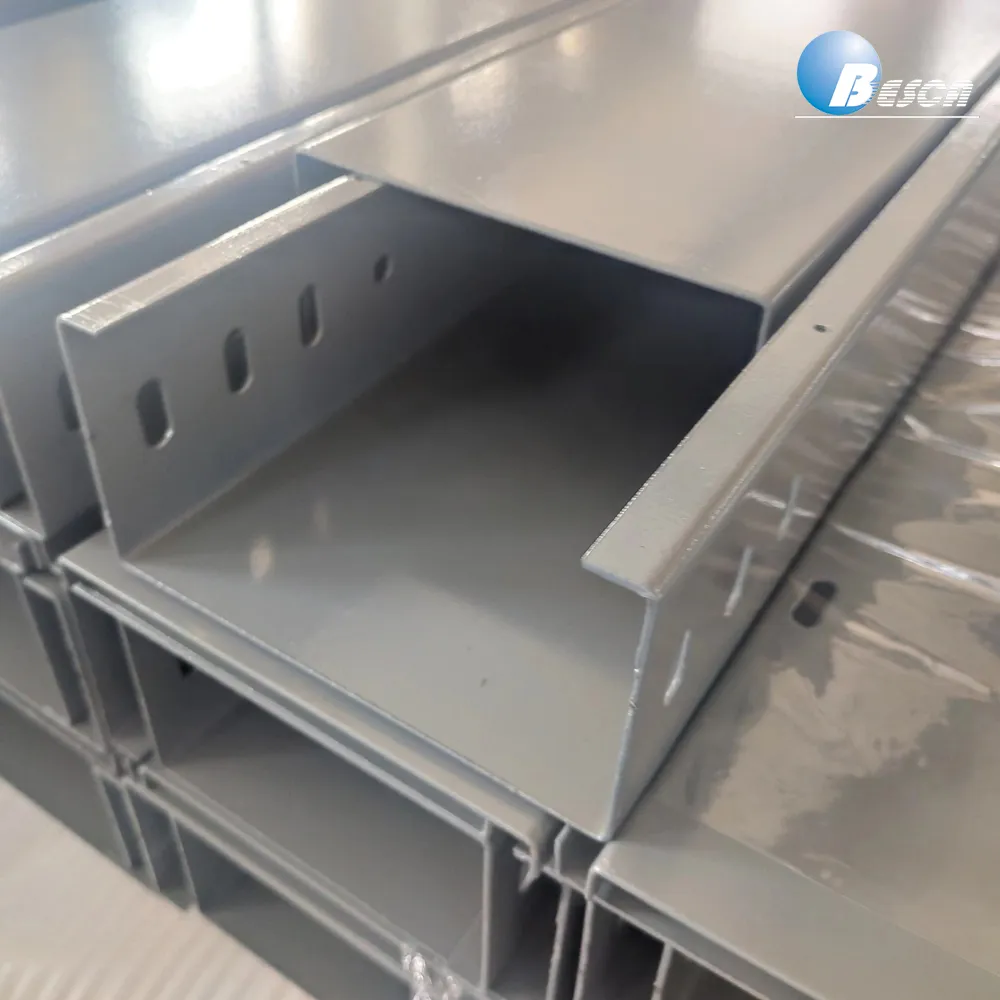 Solid Bottom Cable Tray Metal Cable Trunking
- Shanghai, China+BT+Besca+Max 6000mm+50mm, 75mm, 100mm, 150mm
$1.00
MOQ: 1
About Cable Trunking & Solid Enclosed Cable Ducts
In commercial, industrial, and institutional electrical infrastructure, cable trunking represents the definitive containment solution where complete physical isolation and EMI radio-frequency shielding are paramount. Unlike open cable ladders or ventilated perforated trays, solid-bottom trunking shields sensitive low-voltage data cables and fiber optic lines from adjacent high-voltage electromagnetic radiation and environmental contaminants.
Manufactured on precision roll forming lines with continuous inline edge hem folding, our cable trunking side walls incorporate smooth return edges that eliminate cable abrasion while providing a continuous spring-tensioned locking track for snap-on covers. For demanding industrial applications, turn-buckle or screw-secured covers are available to guarantee tamper-proof security and ingress protection up to IP40/IP54.
Trunking configurations span single-compartment channels as well as multi-compartment designs utilizing integral spot-welded or slide-in dividing fillets. Multi-compartment trunking allows power cables, telephone lines, and building automation control circuits to share a single compact trunking channel while maintaining strict physical segregation required by international wiring codes. System components include complete sets of radius-curved gusseted horizontal 90° bends, internal and external tees, crossover units, end caps, and wall mounting brackets.
Applications
Commercial Office Raised Floor & Underfloor Modular Cable Trunking
In commercial office raised floor & underfloor modular cable trunking, multi-compartment galvanized steel cable trunking installed beneath raised access floors in modern commercial office complexes, distributing power, CAT6A data, and telecom wiring to workstation flush service boxes. These rigid galvanized and stainless steel cable pathways provide superior structural span capacity, facilitate heat dissipation, and support high-voltage power networks.
Pharmaceutical Cleanroom & Food Processing Washdown Cable Ducting
In pharmaceutical cleanroom & food processing washdown cable ducting, smooth-ground 316L stainless steel gasketed cable trunking with sloped shed covers installed in sterile pharmaceutical cleanrooms and food processing packaging lines. Featuring high load-carrying capacity and modular hardware, these certified cable routing systems protect critical cabling while enabling organized overhead deployment.
Automotive Factory Robotic Assembly Cell Sensor & Power Trunking
In automotive factory robotic assembly cell sensor & power trunking, heavy-duty enclosed steel trunking mounted along automotive robotic welding cells and automated stamping lines, protecting servo motor power feeds, bus lines, and pneumatic hoses from welding spatter. Engineered with smooth edges and ventilation patterns, these modular cable raceways prevent insulation damage and ensure continuous electrical earth bonding.
High-Voltage Electrical Substation Switchgear Secondary Wiring Trunking
In high-voltage electrical substation switchgear secondary wiring trunking, solid-bottom steel cable trunking routing auxiliary protection wiring, CT/PT measurement signals, and SCADA monitoring cables between high-voltage switchgear panels and control room consoles. These rigid galvanized and stainless steel cable pathways provide superior structural span capacity, facilitate heat dissipation, and support high-voltage power networks.
Hospital Bedhead & Critical Care ICU Power & Data Trunking Modules
In hospital bedhead & critical care icu power & data trunking modules, precision multi-channel architectural aluminum and steel trunking mounted horizontally behind hospital patient beds, housing medical gas pipes, isolated power circuits, and patient monitoring cables. Featuring high load-carrying capacity and modular hardware, these certified cable routing systems protect critical cabling while enabling organized overhead deployment.
Technical Overview
| Parameter | Information |
|---|---|
| Governing Standards | BS 4678 Part 1 / IEC 61537 / EN 50085 / UL 870 |
| Trunking Profiles | Solid Bottom Single Compartment / Dual Compartment / Triple Compartment with divider |
| Material Composition | Pre-Galvanized Steel (Z180–Z275), Hot-Dip Galvanized, Stainless Steel (304/316L) |
| Width Dimensions | 50 mm, 75 mm, 100 mm, 150 mm, 200 mm, 250 mm, 300 mm (2 in to 12 in) |
| Depth / Height Dimensions | 50 mm, 75 mm, 100 mm, 150 mm (2 in to 6 in) |
| Sheet Metal Thickness | 1.0 mm, 1.2 mm, 1.5 mm, 1.6 mm, 2.0 mm (Heavy industrial duty) |
| Cover Locking Types | Tool-less Snap-On spring cover, Turnbuckle quick-release, Screw-fixed with captive nuts |
| Standard Unit Length | 2.44 m (8 ft) and 3.0 m (10 ft) with precision punched joint holes |
| Environmental Ingress Protection | Standard IP40; Optional continuous closed-cell neoprene gasketed IP54 / IP65 |
| Modular Fittings Suite | Flat 90° elbows, inside/outside risers, tee pieces, cross junctions, reducers, flanged end caps |
Related Solutions
Cable Tray Roll Forming Solution
Cable tray / ladder line, 50-600 mm width. Example: 1-2 mm, 200 t punch, 6-10 m/…
Custom Profile Roll Forming for OEM
Flexible roll forming line for custom cross-sections. Suitable for OEMs who need…
Light-Gauge Keel Roll Forming Solution
Light-gauge keel package: partition stud and track, ceiling T-grid, furring, or…
Solar Mounting Roll Forming Solution
Solar strut / hat-bracket mill for PV mounting. Example: 24 stands with cooling,…
Pre-Engineered Building Component Line
Integrated solution for PEB secondary framing: C/Z purlins, girts, eave struts,…
Metal Sheet Processing Solution
Blanking and cut-off around a roll former is a shear class: flying (tracking) sh…
Related Information

What Is a Cable Tray Roll Forming Machine? Tray, Trough & Ladder Explained
cable tray roll forming machine, cable trough roll forming, cable tray making ma…
Read More
Cable Trays and Cable Ladders: Roll-Formed Profiles and Standards
Perforated trays, ladder trays, wire mesh - each rolls from steel or aluminum co…
Read More
Pre-Punching vs Post-Punching in Roll Forming
Punch the holes before or after forming? The choice changes hole accuracy, tooli…
Read More
Galvanized Coil Specifications for Roll Forming: ASTM A653 vs EN 10346 vs JIS G3302
galvanized coil specifications astm a653 en 10346 jis g3302
Read More
Galvanized Steel Roofing Sheets: SGC400, Z275, and Coating Standards Explained (2026)
Understand SGC400, Z275 and related coating standards for galvanized steel roofi…
Read More
Surface Scratching on Prepainted (PPGI) & Galvanized Coils: Prevention in Roll Forming
surface scratching prepainted ppgi galvanized coils prevention roll forming
Read More
FAQ
What is the primary difference between cable trunking and cable trays?
Cable trunking features an enclosed solid bottom with a complete removable cover to protect cabling from dust, physical damage, and EMI interference, whereas cable trays are open or perforated systems designed primarily for cable ventilation and rapid drops.
How does multi-compartment cable trunking benefit installation projects?
Multi-compartment trunking incorporates internal metal dividers that segregate high-voltage power cables (230V/400V) from sensitive low-voltage data and communication lines within a single duct, saving wall space and installation labor while preventing crosstalk.
What cover locking mechanisms are available for cable trunking?
We supply spring-lock snap-on covers (for rapid tool-free maintenance access in offices), quarter-turn turnbuckle covers (for quick inspection in industrial plants), and tamper-resistant screw-fixed covers (for public infrastructure).
What ingress protection (IP) ratings are achievable with cable trunking?
Standard trunking achieves IP30 to IP40 dust protection, while gasketed neoprene-sealed weatherproof trunking versions achieve IP54 to IP65 ratings for washdown environments and outdoor installations.
Can cable trunking be installed in raised access floor systems?
Yes, our low-profile underfloor trunking systems (side heights 25 mm to 50 mm) are specifically designed for installation beneath modular raised computer access floors, complete with integrated service outlet boxes.
What materials and surface treatments are standard for cable trunking?
Standard materials include pre-galvanized sheet steel (BS EN 10346, Z275), hot-dip galvanized steel after fabrication (BS EN ISO 1461), electro-galvanized steel with epoxy polyester powder coating, and stainless steel AISI 304/316.
How is electrical earth continuity maintained across trunking joints?
Every trunking section is joined using internal or external connector sleeves secured by copper-plated bonding screws, or equipped with dedicated copper earth bonding braids across joints to ensure low ground fault impedance.